
Is The Mental Health Crisis Due to a Resilience Deficit?
Are you wondering about the continued increase in mental health?
We are witnessing a profound erosion of emotional and social stability in workplaces, communities, and societies around the world. Burnout rates are escalating across every sector. Random acts of violence are increasing on the streets, schools and playgrounds. Conflict, hostility, and polarization are rising in communities that once held together. People are reacting with impulsivity, aggression, avoidance, loneliness, and despair.
The default response has been to call this a mental health crisis. Governments, organizations, and media outlets frame it that way because the symptoms are visible and the language is familiar. Depression, anxiety, burnout, disengagement. These are the words that show up in headlines, in benefit program brochures, and in boardroom presentations when leaders try to explain why their workforce is struggling.
The symptoms are real. The diagnosis, however, is incomplete. It names what is happening on the surface without ever asking what is driving it underneath.
What No One Seems to Ask
For 28 years, I have been called into organizations as a Conflict Analyst when disruptive situations threatened to pull teams apart. In every engagement, I listened carefully to what people were saying and, more importantly, to what they were not saying. It became clear, consistently, that conflict was the tip of the iceberg. Beneath the anger, resentment, and dissatisfaction were deeper hidden stressors that had been eroding well-being long before any crisis emerged.
I kept seeing the same pattern: people struggling in key areas of life and work that traditional approaches never addressed. Leaders noticed the symptoms, low morale, rising conflict, declining engagement, and they responded the way most organizations respond. They ordered workshops, expanded EAP access, launched wellness apps, and brought in motivational speakers.
What no one seemed to ask was where the depletion was actually coming from, instead of just managing the symptom but addressing to the actual source.
The Distinction That Changes Everything
Depression, anxiety, and burnout are downstream consequences of something deeper, such as depleted resilience capacity. When emotional, social, occupational, and interpersonal resilience become chronically depleted, the conditions we label as mental health issues emerge as the body and mind’s warning system. They are signals, not starting points.
This matters because the solution for a mental health crisis is fundamentally different from the solution for a resilience crisis. If the diagnosis is mental health, the response is therapy, medication, wellness benefits, and crisis support. Those interventions are necessary and they save lives. They also address the problem after it has already developed, which means organizations are always reacting to the crisis rather than preventing it.
If the diagnosis is depleted resilience, the response is starts with measurement, to identify which specific dimensions of capacity are eroding, how deep the depletion goes, and what is driving it. The intervention is targeted, because the root cause has been named.
Treating the symptoms without rebuilding resilience capacity is like bailing water from a sinking boat without repairing the hull. The effort and intention is sincere but the issues still remain.
Resilience Operates Across Nine Dimensions
Resilience is our ability to recover from challenges, adapt to change, and maintain perspective under stress. Without it, individuals and societies become fragile, because the capacity to self-regulate, empathize, and process adversity erodes. Those are the foundations of healthy human interaction.
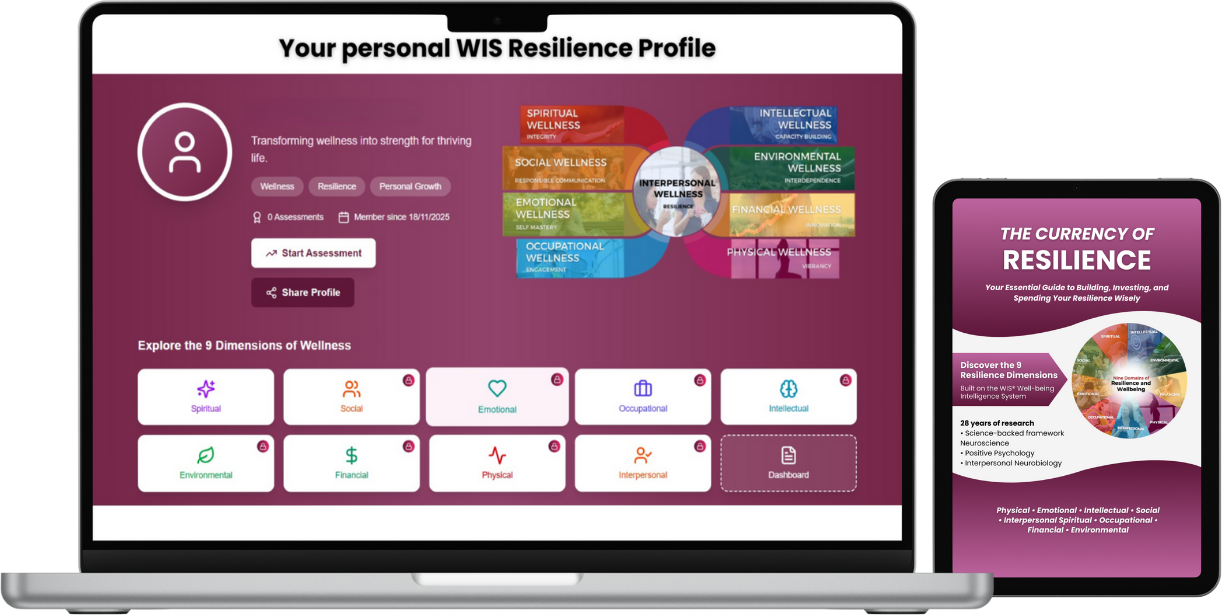
The WIS® Well-being Intelligence System measures resilience across nine interconnected dimensions: spiritual, social, emotional, occupational, intellectual, environmental, financial, physical, and interpersonal. Each dimension is distinct, and depletion in one affects the others. Someone who is financially strained does not leave that stress at the door when they walk into work. Someone carrying emotional weight from a difficult relationship does not suddenly become fully present in a team meeting. The dimensions are connected, so when one drops, others follow.
The WIS® Resilience Index identifies where resilience is breaking down before crises occur, providing organizations with the diagnostic intelligence to intervene proactively rather than reactively. That shift, from reactive crisis management to proactive resilience building, is the difference between spending more every year on the same problems and actually addressing the root cause.
The Evidence Is All Around Us
When people cannot tolerate differences, feedback, or opposing viewpoints, they react impulsively. The consequences spiral from workplace conflicts to community instability. We are seeing the breakdown of individuals and the social fabric that holds organizations and communities together.
For over a decade we have been using WIS® Resilience to help clients address behaviour issues in the workplace. It started slowly and grew to where we are today. The same method we applied with organizations such as Manitoba Liquour and Lotteries, taught at Manitoba Hydro and Standard Aero have expanded into the WIS Resilience platform that now serve organizations, across Canada and continents.
We are diagnosing before prescribing by measuring where capacity is eroding across all nine dimensions before deciding what intervention is needed. The results speak for themselves: reduced conflict, improved engagement, restored capacity.
We are facing a resilience crisis and the sooner we name it correctly, the sooner we can address it at the root. The distinction is not academic. It determines whether we keep managing symptoms indefinitely or finally start rebuilding the capacity that prevents those symptoms from developing in the first place.
If you are tired of addressing the symptoms and are ready to build resilience in your workplace then I encourage you to start the resilience mapping.
→ Start your 30-Day Resilience Mapping to find out where capacity is eroding in your organization. Start Now