
Free assessment · Resilience depletion
Resilience Depletion Workplace Assessment
Is it burnout — or resilience depletion? Find out whether your organization’s everyday practices help employees replenish resilience, or allow demands to wear it down.
Your employees may still be delivering results while their capacity to recover quietly runs low. This check looks at the organizational practices that prevent that pattern.
- 15 practicesScored across 9 dimensions
- InstantReadiness snapshot
- Free guideDownload + email
Approximately 3 minutes is our design target; actual completion time may vary.

Joyce Odidison, MA, MCC, CTDP · Resilience Depletion Theory™
What resilience depletion is
Performance is a poor early warning sign.
Resilience depletion occurs when repeated demands draw down a person’s resilience reserves faster than those reserves are replenished.
Employees can continue delivering results, meeting deadlines and leading teams while the demands of work and life gradually wear down their capacity to recover. Organizations often recognize the problem only when employees become exhausted, disengaged, distressed, or unable to sustain performance — by which point the reserves may already be low.
Resilience reserves
The capacity available to meet demands.
Repeated demands
The withdrawals made against that capacity.
Replenishment
The practices that restore it.
Warning signs leaders should recognize
Five patterns that show reserves are running low
- 01
Declining trust and integrity
Employees experience value conflicts, lose confidence in leadership, or question their sense of purpose.
- 02
Communication and relationship breakdown
Listening decreases, tensions rise, and employees withdraw from collaboration.
- 03
Emotional strain
Frustration, pessimism, emotional outbursts, or persistent distress become more visible.
- 04
Reduced capacity
Concentration, decision-making, motivation, and sustainable performance decline.
- 05
Difficulty recovering
Employees struggle to regain energy and confidence after demanding periods.
These signs may have multiple causes and warrant supportive inquiry rather than assumptions about an individual’s resilience or mental health.
What resilient organizations do differently
They build systems, not one-off wellness activities.
Your organization may already offer wellness benefits, EAP services and leadership development. The more important question is whether those supports address the conditions that continually deplete employees’ resilience.
- 01
Recognize early warning signs across the nine dimensions of wellness.
- 02
Develop capable leaders who listen, respond appropriately, and address difficult workplace conditions.
- 03
Support whole-person well-being, including occupational, emotional, social, financial, physical, and relational needs.
- 04
Create opportunities for replenishment through appropriate recovery, flexibility, connection, and sustainable work demands.
- 05
Measure organizational practices and follow through when employees identify concerns.
The nine dimensions of wellness (9D)
- Spiritual
- Social
- Emotional
- Occupational
- Intellectual
- Environmental
- Financial
- Physical
- Interpersonal
Free organizational self-check
Resilience Depletion Workplace Assessment
About 3 minutes · Private · No employee names required
Resilience Depletion Workplace Assessment
Fifteen organizational practices show whether the conditions that replenish resilience are in place — or whether demands are quietly outpacing replenishment across the nine dimensions.
- 15 scored practices
- 5 quick questions about your organization
- An instant readiness snapshot, plus the assessment guide as a PDF
About 3 minutes. Your answers stay in this browser until you choose to send them to IWS.
Developed as an educational self-check for organizations. Results are indicative and reflect one respondent’s perception — not a validated diagnostic measure, not an employee assessment, and not a legal opinion.
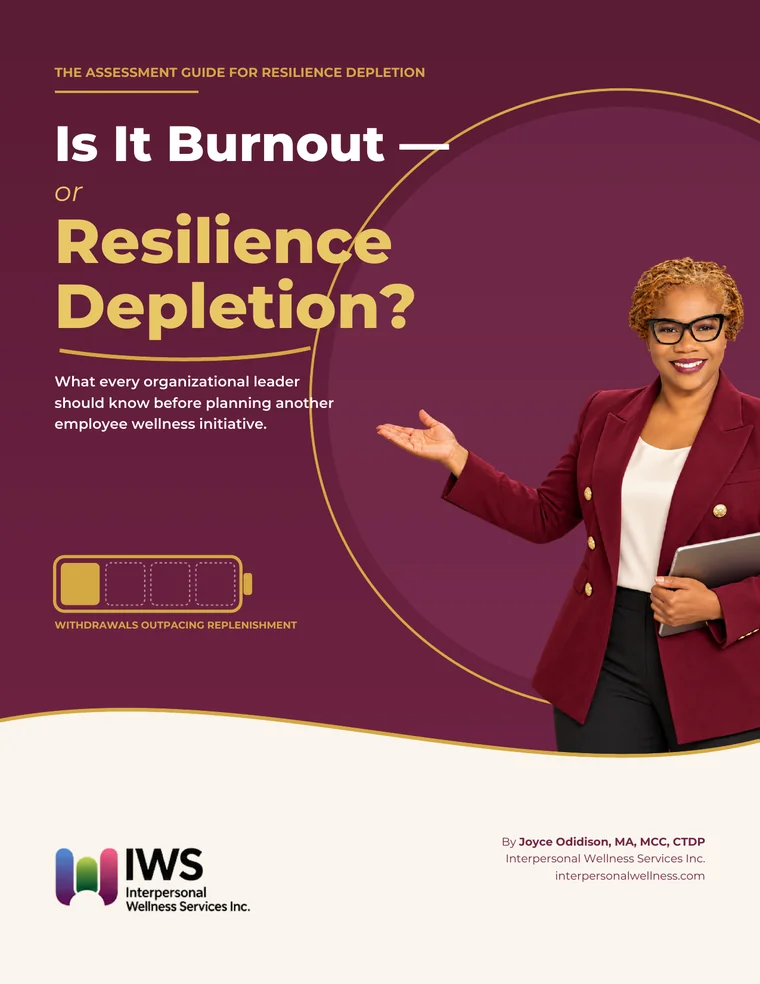
Inside the free guide
What to know before planning another wellness initiative
- How resilience reserves get drawn down, and why performance hides it
- Five warning signs of depletion and what resilient organizations do differently
- The nine WIS® dimensions of wellness and the practices behind each one
- The research behind Resilience Depletion Theory, and the book that explores it
Questions
About the assessment
Is it burnout or resilience depletion?
Burnout describes a state of exhaustion and cynicism. Resilience depletion describes the pattern behind it: repeated demands drawing down a person’s resilience reserves faster than they are replenished. People often keep performing while their reserves run low, which is why organizational practices matter more than waiting for visible burnout.
What does the assessment actually score?
Fifteen organizational practices across the nine WIS® dimensions plus whole-person conditions — from psychological health and safety to sustainable work demands, leadership capability, financial well-being and recovery after demanding periods.
Who should complete it?
HR and people leaders, executives, directors and managers who can see how the organization actually operates. It reflects one respondent’s perception of organizational practice; to compare perceptions, have several leaders complete it.
Does it assess individual employees?
No. It assesses organizational practices, never individual resilience or mental health. No employee names or confidential details are required, and “Not sure” answers are excluded from the score and flagged for verification.
Next step
Turn the snapshot into a resilience strategy
Tell us what you are seeing in your teams and we will map it against the nine WIS® dimensions, then recommend the right next step — no generic wellness pitch.